
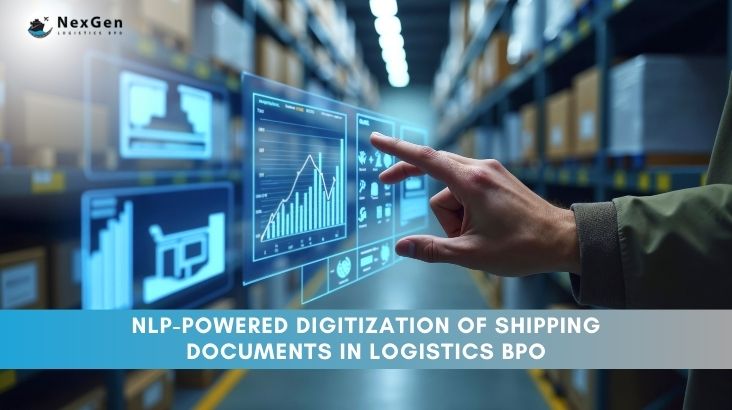
Logistics BPO sits right at the intersection of the three Vs— vulnerability, velocity, and volume. Commercial invoices, Bills of Lading, packing lists, custom forms, and airway bills— each document is crucial. Yet, they are still processed manually or semi-automatically.
This is where NLP shipping document digitization BPO services come into play. The approach changes the equation completely, not by simply reading the documents faster, but by structurally understanding logistics language. This further slashes downstream errors and unlocks operational intelligence that traditional OCR never could.
From static OCR to context-aware intelligence: The true transition
Traditional OCR converts images into text, which is often unreadable and inaccurate. NLP goes several layers deeper by interpreting context, relationships, and intent within the text. What most sources miss is that shipping documents are never uniform— they are jurisdiction-driven, carrier-dependent, and exception-heavy. With NLP in logistics, businesses can:
- Distinguish between shipper, consignor, and exporter based on document context, and not labels
- Normalize inconsistent units, date formats, and currencies across multifarious regions
- Identify HS codes even when embedded in narrative descriptions
The result isn’t just shipping document digitization— it’s semantic standardization, which is where real BPO efficiency begins.
Why logistics BPOs bleed money without NLP (quietly)?
Manual document handling doesn’t fail loudly. Rather, it happens incrementally. The hidden costs start adding up in places where most dashboards can’t track. Below are a couple of key cost leak points that NLP-based logistic BPO models can address.
- Client disputes arising from invoice mismatches or incorrect freight classifications.
- Rework loops caused by misread fields that can trigger custom holds.
- SLA penalties due to downstream delays in documentation approval.
NLP reduces these not by acceleration alone. Instead, it leverages first-pass accuracy in complex fields, especially in areas where OCR flags as “low confidence” and sends the documents to human review further. In high-volume BPOs, even a 1% reduction in exception rates can translate quickly into six-figure annual savings per client.
Exception handling is where NLP actually earns its ROI
Most automation initiatives focus only on the happy paths. However, logistics continue to live in exceptions. However, with NLP-driven automated shipping bill conversion services, businesses can enjoy accelerated excellence in:
- Flagging logistical inconsistencies like weight vs package anomalies
- Detecting missing mandatory fields based on destination country rules
- Identifying documents that look complete but fail to adhere compliance logic
Instead of routing everything to human reviewers, NLP models allow BPOs to triage exceptions intelligently, sending only high-risk cases for manual judgments and interventions. With this, the focus shifts from human-based data entry tasks to judgment-based resolutions, which are more scalable and defensible to enterprise-level clients.
Multilingual documents are not the real problem— Mixed language is
When it comes to document automation, the real challenge lies in code-switching. For example:
- English headers with local-language descriptions
- Carrier-specific abbreviations mixed with regulatory terminology
- Handwritten annotations layered on standardized forms
NLP models that are trained on logistics corpora can resolve meaning across these mixed language signals— something rule-based systems continue to fail at. For BPOs serving EU, APAC, and LATAM trade lanes, this capability directly impacts client satisfaction and customs clearance speed.
Compliance isn’t just about accuracy— It’s about auditability
Digitization without any form of traceability paves the road for potential business risks. That’s why leveraging advanced NLP systems has become crucial in today’s time, as they help maintain:
- Explainable extraction logic for client reviews and audits
- Confidence scoring at the field level
- Version histories for overridden or corrected data
Thanks to this, businesses can:
- Provide trade audits when customers demand proof of compliance
- Answers every inquiry regulators make about documentation decisions months later
- Defend SLA adherence contractually
NLP enables defensible automation, not just black-box processing— an increasingly crucial differentiator in enterprise logistics contracts.
NLP turns documents into data assets, not just records
Once shipping documents are digitized structurally, they are no longer treated as static files. Rather, they become queryable datasets, allowing logistics BPOs to:
- Benchmark carrier documentation quality
- Identify recurring error patterns by lane or shipper
- Proactively advise clients on compliance risks
Conclusion
NLP-powered digitization is no longer a tactical upgrade for BPOs handling logistics— instead, it’s a structural advantage. By transforming shipping and export documents into auditable, context-aware data assets, NLP slashes hidden cost leakage, improves exception handling at scale, and strengthens compliance adherence. To top it off, it enables businesses to move past transactional processing into insight-driven partnerships with clients across the world.

 NexGen Logistics BPO is a well-esteemed name in the global outsourcing market, employed with a dedicated bunch of employees who work on a 24*7 basis to deliver the finest results.