
If you’ve ever worked in or around a warehouse, you know how fast data piles up. Stock levels shift constantly. Shipments come and go. Orders keep coming in, and someone has to make sure all of them get recorded accurately inside the warehouse management system. But there are many teams that fail to do the task internally.
This is where many businesses opt for warehouse data entry outsourcing services instead of keeping things manually and internally. According to Fortune Business Insights, the global warehouse automation market is predicted to surpass $119.86 billion by 2034. This number strongly signals why companies are opting for faster and more accurate business operations.
What Is Warehouse Management System Data Entry?
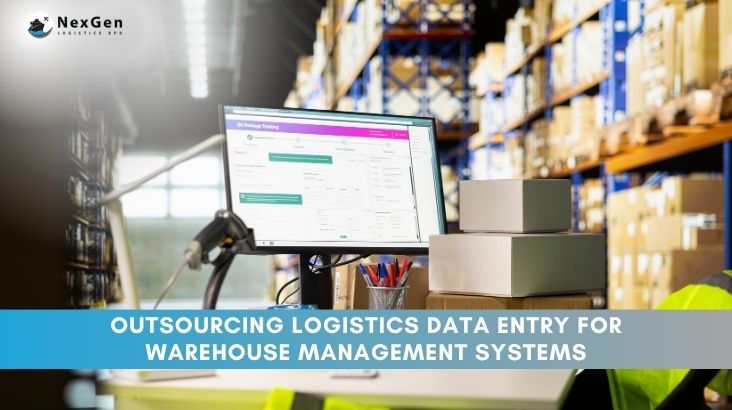
At its core, warehouse management system data entry is an advanced and ongoing process of keeping your WMS fed with accurate and up-to-date information. That means updating inventory counts, managing SKUs, logging shipments, processing purchase orders, handling barcodes and invoices, and documenting returns, everything occurs all under one place.
However, the volume alone is a challenge, but the real issue is what happens when any of that data is wrong. Inaccurate WMS data doesn’t just create issues in the moment, but it affects inventory forecasting, customer satisfaction, and how confidently you can make operational decisions down the line. This is where automated WMS data management makes things easy and error-free.
Challenges of Manual Logistics Data Processing
Businesses with manual logistics data processing face certain challenges that actually impact a business’s position. Here’s how.
1. Inventory Inaccuracies
When someone manually deals with the wrong stock figure, the ripple effect moves fast. You end up selling products that you don’t actually have, or holding inventory that your system thinks is already not in stock. When your team notices it, customers are already gone. Fixing the fallout takes time that your team doesn’t have.
2. Slower Warehouse Operations
Manual data entry is slow, and in warehouses, slowdowns are expensive. When staff are stuck updating records and receiving back-ups, dispatch windows get missed. The whole floor loses momentum. Also, it is very hard to pinpoint exactly where the drag is coming from.
3. Higher Labor Costs
Your warehouse team was hired to run logistics, not to sit and type data into spreadsheets. But that’s exactly what happens when data entry isn’t managed separately. Skilled people end up doing administrative work instead of the operational tasks they’re actually hired for.
Gartner reflects strong data on this problem. Poor data quality costs organizations an average of $12.9 million annually through inefficiencies and errors alone.
How Warehouse Data Entry Outsourcing Improves WMS Efficiency
Warehouse data entry outsourcing improves WMS efficiency through some effective ways. These include –
1. Faster Data Processing and Real-Time Updates
One of the biggest advantages of outsourcing a dedicated team is having accurately processed data. This keeps your inventory levels up to date, and your order accuracy improves noticeably.
According to recent data, almost 80% of warehouse operators are actively speeding up their digital transformation investments to get better operational visibility. Outsourcing the warehouse data entry is one of the most direct ways to get the desired results without huge investments.
2. Improved Accuracy and Compliance
Outsourced data entry teams work without pressure, which means the error rate drops significantly. Your documentation stays consistent, audits become far less stressful, and there is no need to rectify errors by spending a lot of time. When your records are clean and compliant, you can expect better business outcomes.
3. Better Focus on Core Logistics Operations
When someone else is handling the data entry, your internal team gets its time back. They can focus on transportation, fulfillment, customer service, and supply chain decisions. These are the work that actually requires their expertise and judgment. When you opt for outsourced logistics data processing, it changes how your business operations function on a daily basis.
How Automation Is Reshaping Logistics Data Entry
The outsourcing providers are skilled enough to handle the logistics and data entry services.
Businesses use innovative tools such as OCR, AI-assisted validation, barcode scanning, and intelligent document processing. All these methods can handle data faster and catch errors within a very short time before they cause any issues in your system.
However, the real power comes from pairing those tools with experienced human oversight, because no automation catches everything.
IDC, on the other hand, confirms that the AI-assisted business process automation is being adopted at a growing rate across multiple industries, such as logistics and supply chain operations, in 2026. The providers who’ve figured out how to blend these two aspects are the ones delivering consistently better results.
Conclusion
Warehouse runs on data. When that data is accurate and up to date, things become easier. From inventory planning, fulfillment, and customer delivery, everything can be handled without any hassle.
Outsourcing warehouse data entry removes the pressure from your internal team, improves work accuracy and provides flexibility to scale. In 2026, logistics businesses have stopped treating data entry as an afterthought and started treating it as a core part of how they operate.

 NexGen Logistics BPO is a well-esteemed name in the global outsourcing market, employed with a dedicated bunch of employees who work on a 24*7 basis to deliver the finest results.